

Projects
In early 2020 everyone experienced a changed world – and needed to know more about delivering learning online through the pandemic. During 2020 and 2021, we dedicated ourselves to reaching out to educators to share our knowledge, and to ensuring that the projects we had begun were successful. You can see information about our projects below.
Knowledge Transfer Partnership
As part of a Knowledge Transfer Partnership (KTP) with the University of Staffordshire, Nisai is undertaking a programme of research and innovation to better understand who accesses online alternative provision, how learners engage with it, and what happens during and after their time with Nisai. The partnership is part-funded by Innovate UK, part of UK Research and Innovation (UKRI).
Knowledge Transfer Partnerships bring businesses and universities together to apply academic knowledge and expertise to real-world organisational challenges. Within the Nisai KTP, a Research Associate works across Nisai and the University of Staffordshire, combining access to Nisai’s educational data and practitioner expertise with academic research methods and specialist support from the University. This enables findings to be tested and interpreted rigorously, while also ensuring that the research addresses questions that are meaningful in practice.
For Nisai, the partnership is helping to build a stronger evidence base around digital alternative provision and to develop the organisation’s capacity to use data and research effectively. It also creates opportunities for findings from practice to contribute to wider academic and professional understanding of online and alternative education. The result is a two-way exchange: academic expertise informs the development and evaluation of practice, while evidence from practice contributes to research in a field where the evidence base is still developing.
For more information about the partnership please email: research@nisai.com
Units of Sound goes cloud-based
This project extended the reach of the Units of Sound second chance literacy program by converting it to HTML which enabled a cloud-based, mobile version. The project also evaluated the potential for delivery within the United States education system through small partner projects. Units of Sound has supported vulnerable learners in adult literacy projects, young offender institutions, and within the Charter School system.
The project was funded by Oak Foundation’s Learning Differences Programme and we worked in partnership with Georgia State University’s national adult literacy research centre at Atlanta and Betwixt Consulting USA.
Over 4,300 learners have been able to continue on Units of Sound due to the cloud-base, mobile version being available, and a further 3,348 learners have joined since the cloud-based version went ‘live’ in January 2021. In addition, 180 literacy teachers and tutors in 132 schools and teaching centres in the UK and Asia have been trained to deliver the programme. The evaluation of the US market – with a focus on the barriers engendered through market structure and current public service procurement limitations – was published for public information.
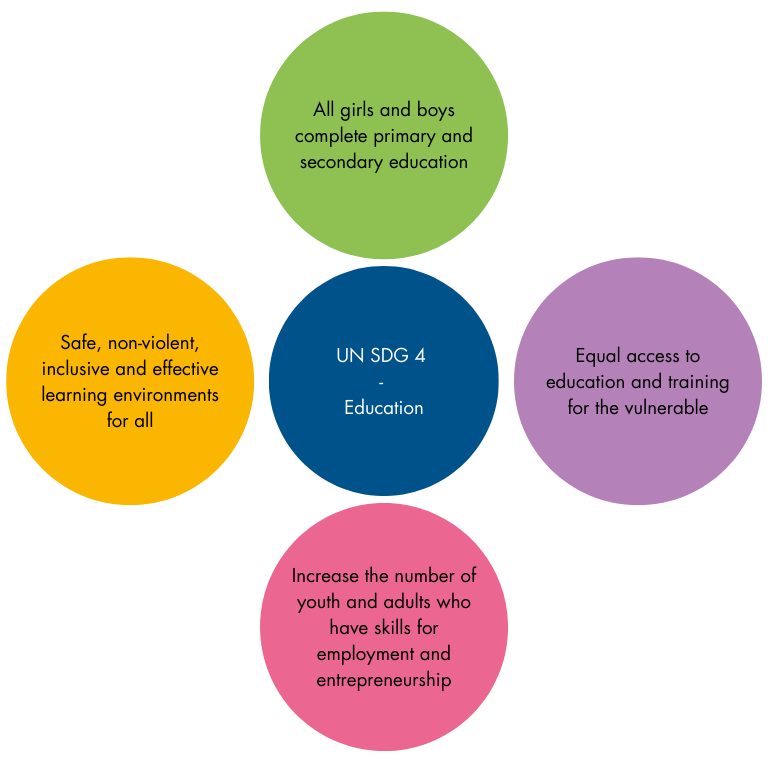
Connecting learners to UN 2030 Sustainable Development Goals
The project developed an innovative pilot programme to learn more about how we can best use blended (online and in-school) experiences to engage young people in the global sustainability agenda. We used our foundation of knowledge and experience to develop a programme that included developing digital capability, digital literacy, personal wellbeing and great teaching.
The project, funded by UNESCO and Nisai Group, targeted 40 children in 10 schools in the Russian Federation. We partnered with UNESCO Institute of Information Technologies in Education and the St Petersburg school district
The project delivered successfully to pupils and schools, with the learning being reported in the project evaluation by UNESCO IITE. Following the project, IITE supported further scalability evaluations in Asia.
NET innovation webinars
The NET Innovation Webinars were initially a response during the coronavirus pandemic to educators’ need to understand best practice in delivering education online, what the impacts on learner and educator well-being were, and how we might incorporate this learning into new models of education following the pandemic. The project continues to bring together experts and outstanding practitioners to hold conversations about innovation in education, online and blended learning to empower and inform educators. The NET Innovation Webinars support educators across the world who need access to expertise on topical issues related to supporting vulnerable students and online/blended learning.
This project was funded by Nisai Global and we worked with many partners, including Achievement for All, Department of Education in The Philippines, the DME Trust, Nasen, PINC College, PRUsAP, Units of Sound, Universities of Bristol, Oxford Brookes and Toronto, Venturers Trust.
So far the NET Innovation Webinars have supported over 1200 educators across four continents as they responded to the challenges of online and blended through and beyond the Covid – 19 pandemic. Educators told us that NET Innovation Webinars brought something of real value at a difficult time, with 100% of attendees rating the webinars as ‘good’ or better.

Guidance for Educators in AP about DME learners
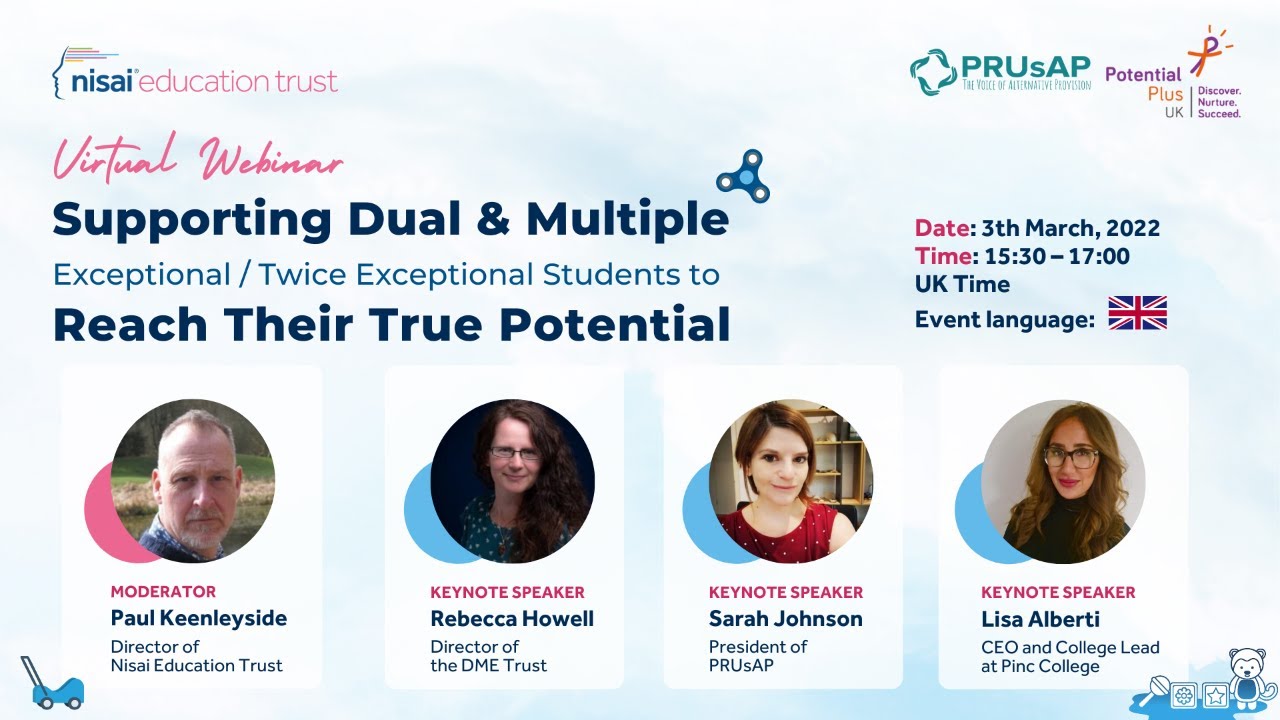
Many children in who have had a rough ride in traditional education have hidden talents and abilities. In this project, we worked in partnership with specialist organisations and practitioners in Alternative Provision settings to develop appropriate materials for educators to be able to identify and support the complex needs of children with DME.
The project was funded by Nisai Global, Potential Plus UK and The Potential Trust and we worked in partnership with The DME Trust, PRUsAP, PINC College and Nasen to deliver it.
We delivered downloadable support and guidance on how to identify and support learners with Dual and Multiple Exceptionality whilst we made it available to every teacher in every Alternative Provision setting in England.
Lockdown laptops
We made laptops available to families who had no access to technology during local lockdowns so that children could continue learning, The target group was primary school-aged children in the Philippines who were unable to attend school due to local coronavirus pandemic lockdowns.
The project was funded by Nisai Group and we partnered with Faith Grower School, Philippines. The result was that 60 primary school-aged children were able to continue their education by accessing education programs from Singapore when they could not attend school.

Universal design for learning goes online
This project sought to investigate how the Universal Design for Learning (UDL) model might effectively support teaching on online learning platforms for vulnerable learners. We applied Universal Design for Learning into an extant virtual/blended school – seeking to create an integrated and individualized learning system for pupils.
The aim was to support equity and innovation in teaching and learning and also to identify and disseminate models of best UDL practice. It was undertaken by teachers currently delivering to pupils and the learning was used by educators working in online and blended education with pupils with learning differences, and those deploying the UDL delivery structure.
The project was funded by Nisai Group and we partnered with CAST/UDL. The outcome of the project was that detailed evaluation of how the UDL structure can be applied in the online learning context was developed for the UDL Implementation and Research Network and published online.
Refugee Mother’s literacy
In this innovative project, Nisai Education Trust provided technology and program support to Happy Baby Community to enable refugee mothers (of new-born babies) to develop their English language literacy. The target group was refugee mothers of new-born babies based in London, UK. We worked in partnership with Happy Baby Community and the project was joint-funded by HBC and Nisai Group.
20 refugee mothers had access to online functional language learning throughout the coronavirus pandemic where otherwise their access to learning would have stopped. One of the initial successes of this program has been one mother gaining a place on an MSC course at the University of London. In addition, we have gained further understanding as to the most effective online pedagogy to support the development of functional literacy skills for this vulnerable group.

Knowledge Transfer Partnership Awarded
Nisai Education Trust will support the recently awarded research grant – a Knowledge Transfer Partnership between Nisai Group with Staffordshire University – awarded by UK Research & Innovation (UKRI).
The Staffordshire University team, including Dr Charlotte Fearn who will be embedded within Nisai, will work with to apply academic knowledge and critical understanding of the on-going disruption to children’s progress as part of the long-term fall-out of the Covid-19 pandemic and the cost of living crisis. We know that a significant number of schools and families are continuing to experience real issues in terms of children’s low attendance, poor engagement, and rejection of the formal education system. Key to the success of the project will be involving those children, schools and families in the research and service design.
Dr Jim Pugh, Director of the Institute of Education at Staffordshire University said: ‘We have a track record of research and evaluation projects which fall within the realm of widening access and participation to education, and which align strongly to the projects aims and outcomes. Staffordshire University is really excited to be involved in this project as it presents a novel research and development challenge – developing cutting edge digital approaches to learning and teaching for the compulsory sector.’
The 2.5 year project will find out more about how we can best use non-traditional education to ensure that all children get access to high-quality education. It will then develop innovative services that will enable children and young people to stay engaged in the education process – gaining the outcomes they need and deserve in a rapidly changing economic and technological environment.
Dhruv Patel, Founder and CEO of Nisai Group commented: ‘In an education landscape revolutionised by digital technology we must ensure that we meet the moral and economic imperatives to ensure equitable access to quality education for every learner, regardless of learning need, age, background or socio-economic status. This project is proof of both organisations passion for, and commitment to, that cause!’
As research findings emerge from the project they will be published through both the University and the Nisai Education Trust website.
nasenLIVE 2025
At nasenLIVE! 2025 Nisai Education Trust presented some of the first research findings from the Nisai/Staffordshire University Knowledge Tranfer Partnership:
There has been an understandable post-pandemic focus on attendance ‘at’ education as we all work to bridge developmental gaps in the learning and socialisation of children and young people. It’s also clear that as a pre-cursor to attendance we need to talk about engagement ‘in’ education. The DfE itself identified that:
‘it’s important to recognise that children with long-term medical conditions, serious mental health challenges, or special educational needs and disabilities (SEND) may encounter additional obstacles… schools should engage in compassionate discussions with both children and their families, collaborating to provide tailored support that meets their specific needs.’
DfE ‘Why school attendance matters, and what we’re doing to improve it’ 14 March 2025
We have looked at pupils with often complex challenges who are both on short-term placements, seeking re-integration into their school placements, and those who are completing extended courses – Key Stages 4 and 5. For the latter group successful integration outcomes are all about accessing further education and training opportunities and there seem to be three key factors at play:
1. The importance of the engagement of commissioners in ensuring an effective pathway into the programme but also a pathway back into a positive destination – mitigating against a ‘cliff-edge’
2. The positive impact that a ‘blended’ (on/off-line) programme has on the learner, and in particular, the role of a face-face mentor in supporting engagement and transition
3. The overall levels of learner engagement. Not just in lessons but also in the programme as a whole: having high levels of attendance, undertaking extension activities, assignments, personal development opportunities, impactful CEIAG . From our first look through of the data the online pastoral input and the student support team have the greatest impact on achieving a positive destination.